

Recording and controling the brain during ethological behaviors and development
Neurological diseases often manifest as behavioral deficits and, in many cases, disrupt the formation and maturation of cortical networks. To understand their network-level mechanisms, it is critical to observe and manipulate neural activity during naturalistic behavior and across development—capabilities that current tools do not adequately provide.
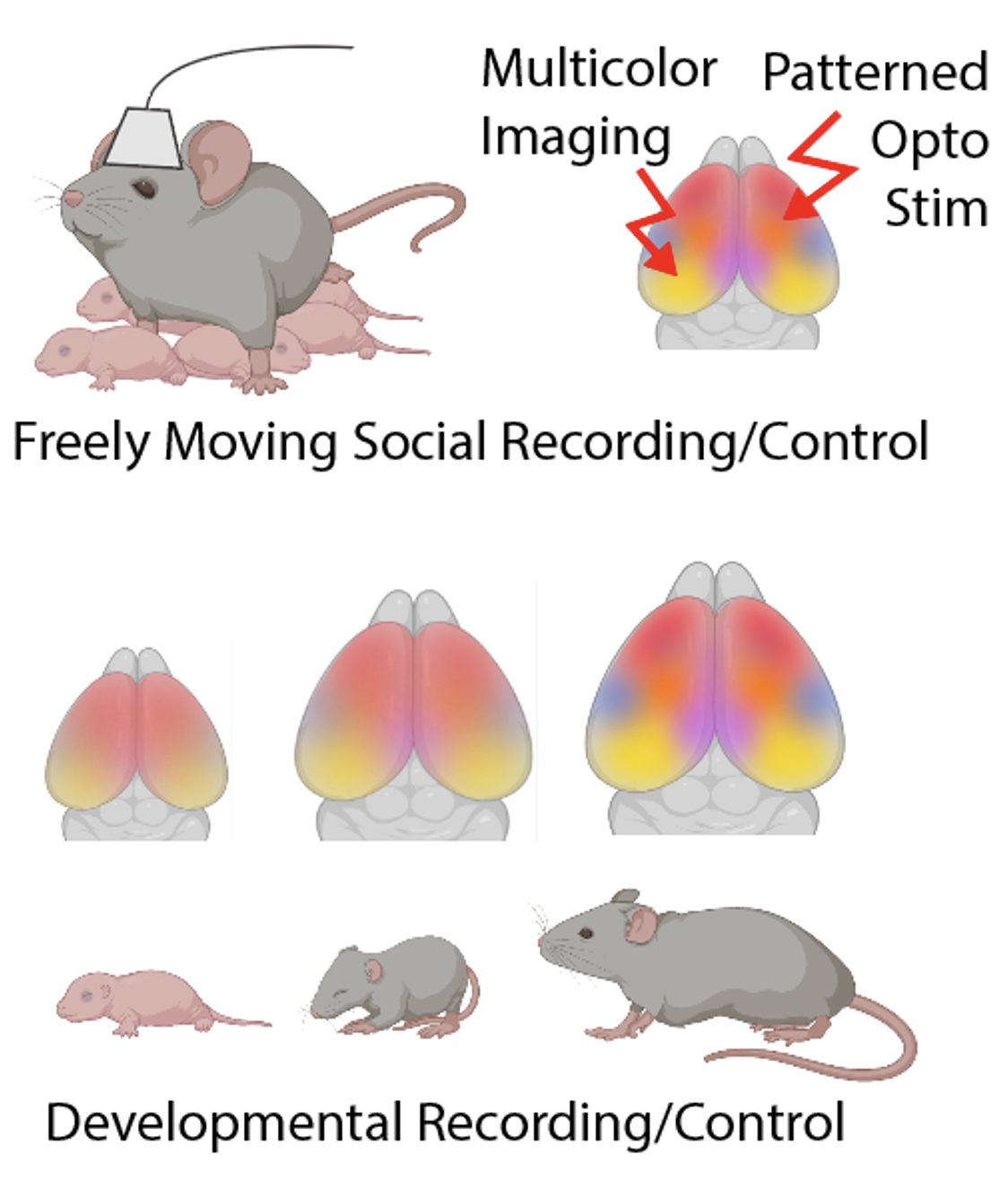
Recording and control during freely moving behavior. We will build on the miniaturized macroscope platform we developed to image and perturb neural activity across the entire dorsal cortex in freely moving animals. Expanding this system to support multi-color imaging of multiple neural populations, I will probe how disease-associated manipulations alter network activity and behavior. In ASD mouse models, for example, I will map differences in excitatory–inhibitory balance and neuromodulatory signaling during social interactions, and assess how prosocial interventions—optogenetic rescue of prefrontal or neuromodulatory circuits and pharmacological agents—reshape these patterns. The ability to manipulate cells across the cortex will enable causal testing of network mechanisms by recapitulating downstream effects optogenetically.
Recording and control during development in awake animals. Developmental disorders often reflect disruptions in cortical network maturation, yet the principles governing network resilience, compensation, and vulnerability remain poorly understood. Remarkably, early-life networks can withstand substantial perturbations while maintaining functionality. Using lesion and genetic models of neurodevelopmental disorders, we will leverage high-resolution longitudinal imaging to track how networks restructure following disruption, identify critical periods for recovery, and determine which perturbations cause lasting deficits. Conventional cranial windows and head-fixation approaches interfere with skull growth, so we will refine a protocol using scalp removal, magnets positioned outside growth plates, and index-matching gel to maintain chronic optical access without disrupting development. To minimize perturbation from indicator and actuator expression, we will use low levels of expression and compensate with an ultrasensitive macroscope capable of capturing network dynamics at high SNR.
Developing a control theory of the mammalian cortex. Access to large-scale, causally manipulable networks provides a unique opportunity to explore cortical control: how can we drive networks toward desired activity patterns or connectivity? When are networks controllable, and with what fidelity? By integrating experimental perturbations with computational modeling, we can iteratively refine models of network control and design more effective interventions.
Bridging single-cell and whole-network dynamics
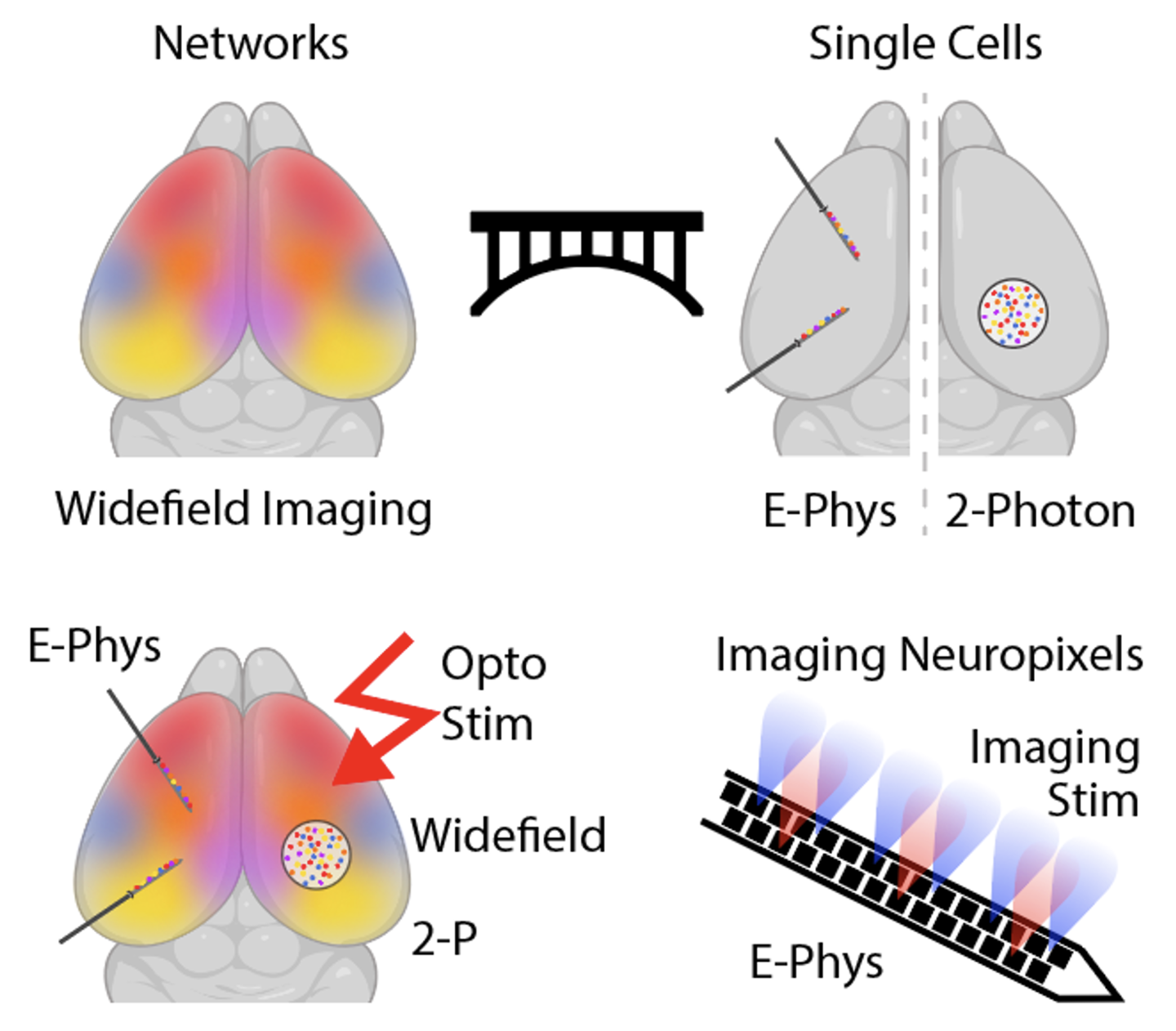
Despite rapid advances in optical and genetic tools, the field lacks a quantitative framework connecting single-neuron computations to emergent network dynamics in health and disease, largely because datasets spanning these scales do not yet exist. The lab will integrate simultaneous mesoscale imaging with targeted electrophysiology and two-photon recordings, generating the critical multiscale datasets needed to study how local circuit dysfunction propagates through networks in disease. We will then apply computational approaches to develop a unified framework linking local and global circuit activity.
Multiscale cortical and subcortical imaging with electrophysiology. We developed a microscope capable of recording and perturbing the entire dorsal cortex at the network level while sampling large populations of single neurons with high-density electrophysiology. We will extend this to a fully integrated system combining widefield imaging, multiphoton imaging, and electrophysiology to capture activity across cortical layers and subcortical regions simultaneously. Electrophysiology probes and multiphoton imaging windows will capture single-cell resolution in targeted regions, while widefield imaging captures global network activity. This multiscale approach will allow us to test how network-level disruptions—such as excitatory/inhibitory imbalance in ASD—propagate to local circuits, impacting signal-to-noise and functional computations.
Minimally invasive probes for simultaneous high-density electrophysiology and optical measurements. Through collaboration with industry leaders, we will develop platforms for simultaneous electrophysiology and optical recording. By integrating a photonic layer beneath the electrode shank and gated single-photon detectors, these probes can deliver excitation light and rapidly collect fluorescence from nearby cells expressing genetically encoded indicators. This enables simultaneous electrophysiology, optogenetic stimulation, and bulk fluorescent measurements of calcium or neuromodulators in genetically defined populations across multiple loci in the brain.
Computational modeling of multiscale dynamics. Drawing inspiration from information theory and statistical mechanics, we will integrate these datasets to discern organizational rules linking single-neuron activity to network-level computations. Key questions include: how does network activity influence local computations? Do large-scale fluctuations shape coding density? How do distant areas communicate, and how do networks reorganize after early-life perturbations? This modeling will help establish a framework connecting single-cell and network-level dysfunction in neurological disorders.
Mapping the (dys)regulation of chemical messengers.
Chemical messengers are essential for brain function and are the primary interface for pharmacological interventions. Their dysregulation plays a central role in neurological and developmental disorders, yet the complex dynamics of their release, interaction, and modulation remain poorly understood. A mechanistic understanding of these regulatory networks is critical for developing new treatments and identifying novel pharmacological targets.
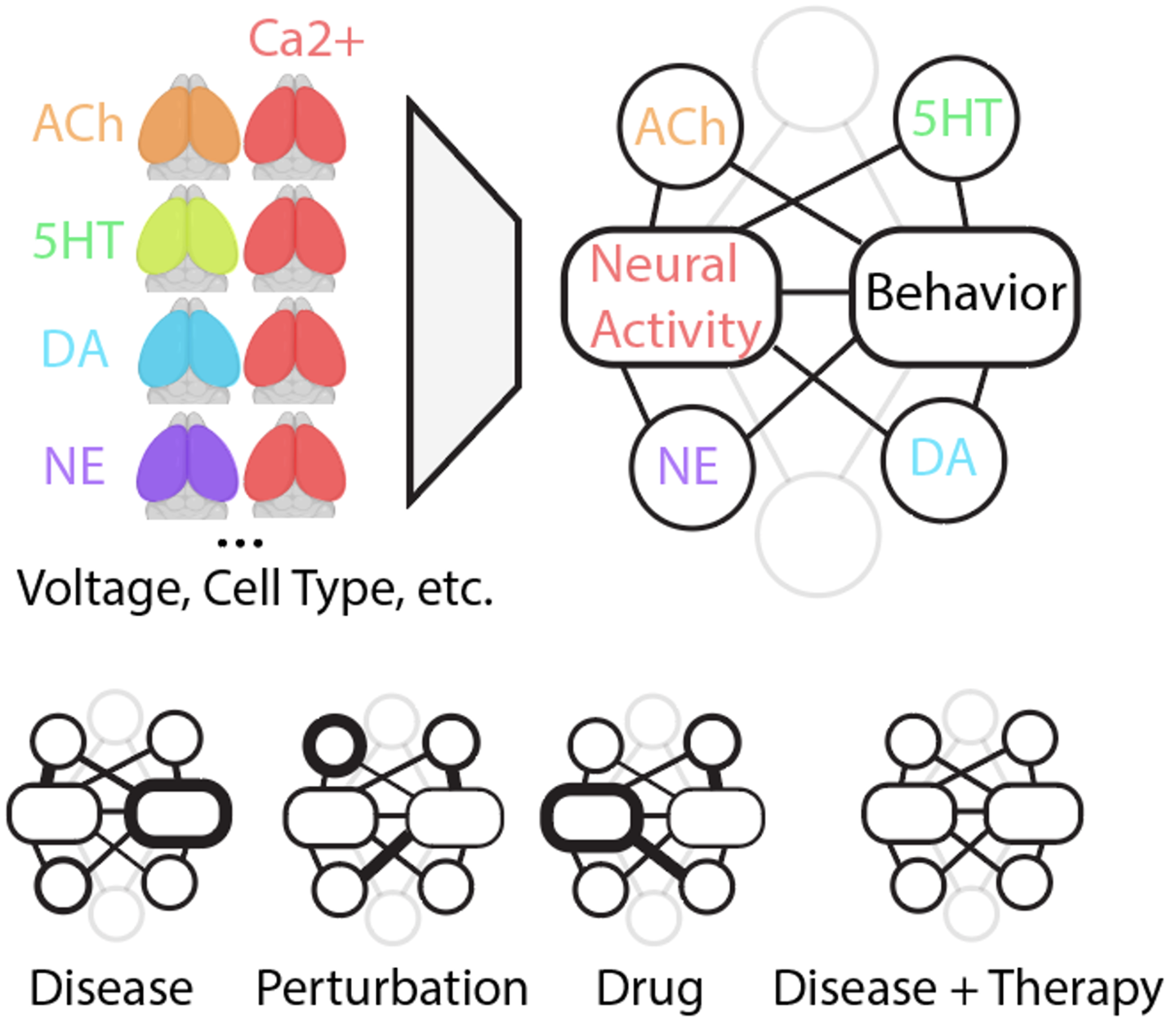
Multiplexed imaging of neural and chemical signals. We have developed a widefield microscope capable of simultaneously recording neural activity, metabolism, and blood oxygenation across the dorsal cortex. Building on this foundation, we will perform two-color imaging to record neural activity along with a single chemical messenger of interest in each experiment. By repeating this across multiple cohorts of animals, each expressing a different chemical sensor but the same neural activity indicator, we can assemble a comprehensive map of how neural activity and chemical signaling interact across the cortex. Synchronizing experiments with precisely timed sensory stimuli and using unsupervised analyses to identify shared neural and behavioral motifs will allow us to uncover conserved patterns of neural–chemical interactions. This framework can then be extended with ethological behavior, developmental tracking, and single-cell electrophysiology from Aims 1 and 2 to create a multidimensional atlas linking activity, chemical signaling, and behavior.
Using atlases to generate insight into disease and pharmacology. Building on the maps we generate, we will compare neural–chemical dynamics across healthy and disease-model animals, as well as under pharmacological manipulations. This approach creates a “digital twin” of cortical network activity, allowing us to identify how disease or drugs alter network interactions. Because all the tools are designed for targeted perturbation, we can then test these predictions directly: for example, by optogenetically manipulating specific neural populations and measuring resulting changes in chemical signaling across the network. Integrating these datasets across multiple messengers, developmental stages, and behavioral contexts will provide a mechanistic understanding of how chemical dysregulation contributes to disease and how interventions restore network function.
Together, these platforms will generate an unprecedented, multidimensional view of the mammalian brain, linking neural activity, neuromodulation, and behavior across scales and contexts. By combining observation and perturbation with computational modeling, the lab will reveal the mechanisms by which networks develop, coordinate, and fail, identify critical points of vulnerability, and uncover causal relationships that underlie neurological disease. This integrated approach promises not only fundamental insight into brain function but also new avenues for therapeutic intervention.
